

Upload documents for international shipments
When you make an international shipment, some carriers may require additional documents besides the commercial invoice to meet customs regulations in the destination country.
In Envia.com you can upload these documents immediately after you generate your label, from the same shipment confirmation screen.
Available carriers
Section titled “Available carriers”This feature is currently available for:
- DHL Express
- UPS
- FedEx
Upload additional documents
Section titled “Upload additional documents”After you complete all shipment data and click Generate label, the system shows the confirmation screen: Shipping label was created successfully.
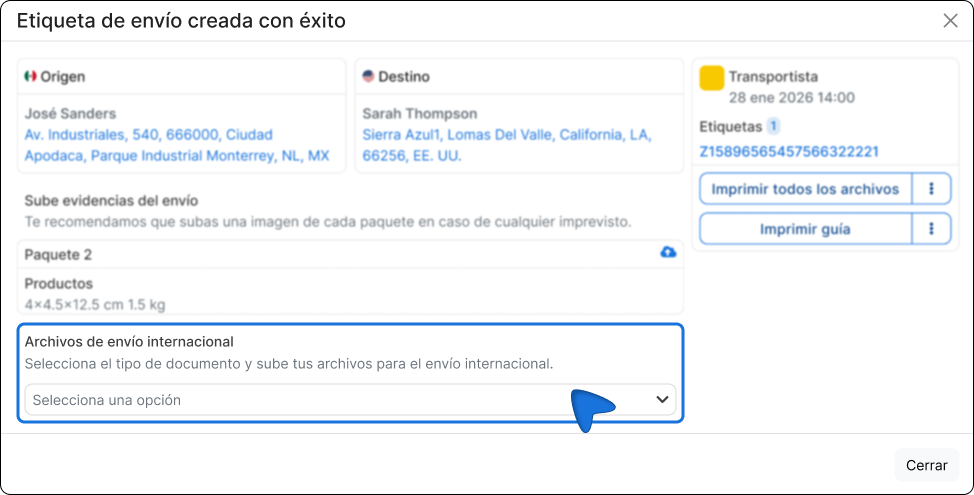
On this screen you will find the International shipping files section.
-
Click the dropdown in the International shipping files section.
-
Select the type of document you want to attach.
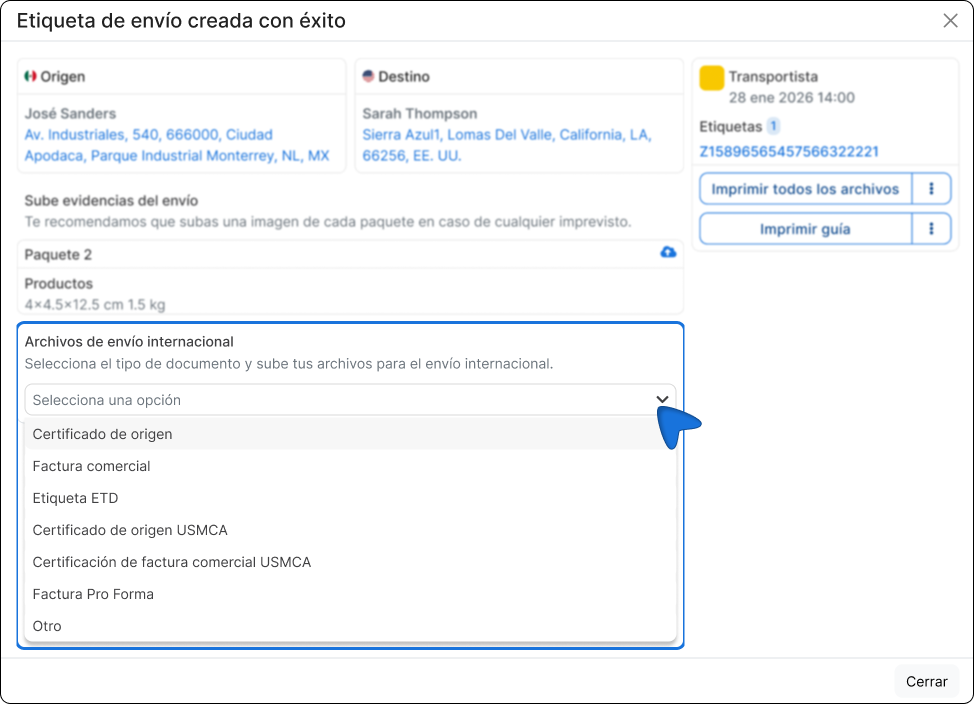
-
Upload the document from your computer. Verify that:
- The document is valid.
- The file does not exceed the allowed size. (5MB)
- The document matches the information declared on the shipment.
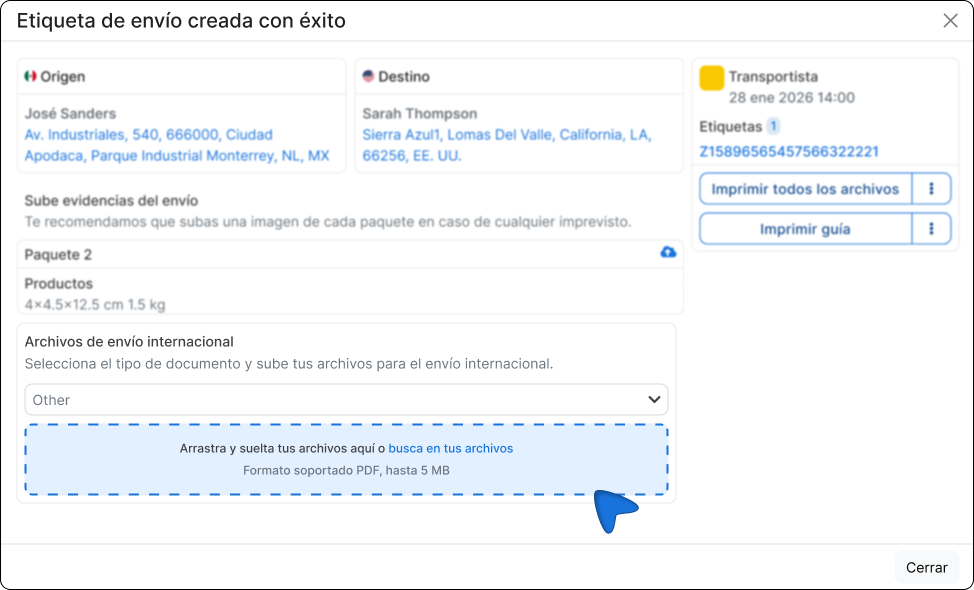
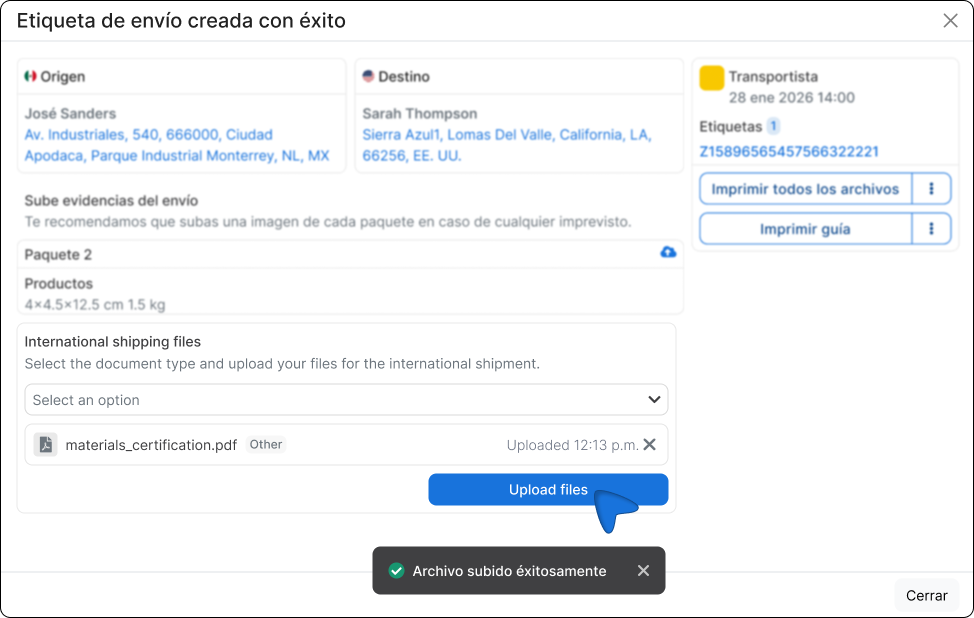
If the file meets the requirements, it is sent automatically to the carrier and associated with your tracking number.
Document types
Section titled “Document types”The available documents can vary by carrier and destination country.
Certificate of origin
Section titled “Certificate of origin”A document that certifies the country where the product was manufactured.
It is used to:
- Apply trade agreements.
- Obtain duty benefits.
- Comply with the destination country’s import regulations.
Commercial invoice
Section titled “Commercial invoice”A commercial invoice that describes:
- Products shipped.
- Quantities.
- Declared value.
- Sender and recipient information.
Customs uses this document to calculate taxes and validate the merchandise.
ETD label
Section titled “ETD label”An electronic document associated with the Electronic Trade Documents (ETD) system.
It lets commercial documentation be transmitted digitally to the carrier without needing to provide extra physical copies (depending on the country and the carrier).
USMCA certificate of origin
Section titled “USMCA certificate of origin”A certificate of origin under the trade agreement between:
- United States
- Mexico
- Canada
It is used to apply duty benefits when the merchandise meets the origin rules established in the agreement.
USMCA commercial invoice certificate
Section titled “USMCA commercial invoice certificate”An integrated version where the USMCA origin certification is included in the commercial invoice.
It is used when:
- The operation requires both a commercial invoice and treaty certification.
- The exporter wants to simplify documentation.
Proforma invoice
Section titled “Proforma invoice”A proforma invoice used when:
- The merchandise does not have a final commercial value.
- It is samples, gifts, or shipments without a sale.
It is used to declare the estimated value to customs.